The aim of the SOBI Seminars is to provide a forum for novel scientific findings and ideas in all areas of plant and animal sciences which are addressed within the Section for Organismal Biology. In order to fulfill this aim a two-monthly seminar series is organized. The seminars will be held every other week on Friday, alternating between internal and external speakers.

28 May 2010: Johannes Kollman


Challenges in restoration ecology - plans for future research in Munich


Johannes Kollmann

dept. Agriculture and Ecology, Copenhagen University


The current erosion in biodiversity and the degradation of ecosystem services are major challenges for biological conservation. Often conservation comes virtually too late, and restoration of impacted ecosystems is the only appropriate option. This has been realized for mining landscapes, postindustrial regions and degraded ex-arable land. More recently, urban ecosystems and infrastructure projects call for innovative planning strategies where ecologists, landscape planners and architects cooperate. Thus, restoration ecology is a young discipline which has developed in response to current environmental problems; it has a problem-oriented and interdisciplinary approach drawing on classical theories and recent advances in ecology. Some people call restoration ecology the “acid test” of ecological theory.

The Technical University Munich has established one of the first chairs in restoration ecology in Europe, and it offers a great chance to contribute to this research field in the coming years. In the seminar I want to summarize the work I have been doing in the past decade or so, and to describe the research plans I have when moving to Munich. I will try to make the presentation interesting to a non-specialist audience, and I would love to see all colleagues and other members of staff that have helped me during my time in Copenhagen.

23 April 2010: Tina D'Hertefeldt


Gene flow in Brassica napus: effects on herbivory, ferality and the seed bank


Tina D'Hertefeldt

dept. Plant Ecology and Systematics, Lund University, Sweden


Worldwide cultivation of oilseed rape (Brassica napus), which is second only to soybean for oil production, covered 28 million hectares in 2008. In Sweden, oilseed rape was grown on 110 000ha. With large land areas devoted to oilseed rape production, the crop becomes highly important to both natural and agricultural ecosystems. B. napus has been implemented as a species with high capacity for both volunteer and feral population establishment due to large seed production, long-term seed dormancy and potential for out-crossing with wild relatives.
The wild relative B. rapa ssp. sylvestris which was previously a common agricultural weed is now assumed to be threatened. Furthermore, varieties of genetically modified oilseed may be cultivated in the EU countries in future and it is therefore important to evaluate the effect of potential B. napus gene flow on wild B. rapa. The effects of increased insect resistance on wild B. rapa, and the roles of feral B. napus and the B. napus seedbank in spatial and temporal B. napus gene flow will be discussed.

09 April 2010: Honor Prentice


Studying diversity in a messy reality:
genes and species, ecology and adaptation, history and landscapes


Honor Prentice

dept. Plant Ecology and Systematics, Lund University, Sweden


Grassland ecosystems are beautiful, complex and extremely challenging to study. The structure of genetic variation within and between populations and its relationships with stochastic and adaptive processes on different spatial and temporal scales; the relationships between species richness and environmental, stochastic, historical and spatial processes; the relationships between genetic variation and plant community composition – how does everything fit together? Does it all fit together? I suggest that conservation biology in general, and conservation genetics in particular, should pay more attention to the possibility of local adaptation. And that studies of associations between biodiversity and environmental or historical variables need to include simultaneous analysis of a range of variables.


26 March 2010: Thure Hauser


Frequencies and effects of hybridisation between two arctic plant species: Pyrola grandiflora and P. minor

Thure P. Hauser

dep. Agriculture & Ecology, Copenhagen University


In the Arctic, hybridization, polyploidisation and introgression have been important for the evolution of the flora. With the predicted and ongoing change of climate, there will be an increased influx of plants from warmer parts of Eurasia and America. The fate of these newcomers, and of the resident species, will depend on the competitive and reproductive interactions between them.

Two species of Pyrola (Danish: vintergrøn) grow in Greenland. Both have a circumpolar distribution, but P. minor has a more southern distribution including Europe. At Disko Island on the west coast, P. minor has its northern limit, and hybridizes with P. grandiflora. In a project financed by the Carlsberg Foundation, we study the dynamics of hybridization between the two species to evaluate how hybridization may affect their distributions locally and regionally. Last summer we collected material to test if hybridization has led to integration of genetic material of one species into the other (introgression) by characterizing the genetic and morphological composition of local populations of the species. To test how easy it is for the two species to hybridize, we further did controlled pollinations between the species and hybrids and evaluated to what extent seeds are produced. In the coming summer, we will survey how often plants are actually pollinated, how well foreign pollen grows in the styles, and how successful hybrids grows in the habitats of the parental species.

12 March 2010: Bodil Ehlers


Adapting to your chemical neighbor: Thyme and its associated plants

Bodil K Ehlers

Institute of Biology, University of Southern Denmark


It is well known that plant allolochemicals can have profound effects on associated species, and that plants with a history of co-existence with chemical neighbour plants perform better in their presence compared to naïve plants. This suggests that plant communities may indeed be quite co-evolved and that associated plants may locally adapt to the presence of a “chemical neighbor” plant.

The genus Thymus is known for its production of aromatic compounds, whose main constitution is terpenes – mainly monoterpenes. The thyme genus has a genetic polymorphism for the production of these terpenes both within and among species. These monoterpenes are known to differentially affect performance of herbivores, soil-microorganisms, and the germination and growth of other plants. We have studies how associated plant species perform under the influence of thyme monoterpenes, and found that a number of plant species show an adaptive response to growing with their “home” terpene. In a recent study we demonstrated that associated plants show genetic variation for the sensitivity to thyme monoterpenes, and that this variation is in accordance with selection operating, thus suggesting that the presence of thyme plants in a community can act as a selective agent on the genetic variation of associated plants. Moreover, we have evidence that the outcome of the interaction with thyme and associated plants is strongly affected by the presence of soil microorganisms. I will present these findings and future plans and discuss how biotic interaction and intra species genetic variation can affect community structure and evolution.

26 February 2010: Mona Chor Bjørn


Landscape architecture, ecology and horticulture - an interdisciplinary approach to planting design

Mona Chor Bjørn

dept. Forest and Landscape, University of Copenhagen

Landscape architecture is about solving specific solutions for green spaces in an artistic way, based on knowledge from ecology, sustainability, social needs and materials. Central in landscape architecture is planting design. In Danish landscape architecture research in use of herbaceous vegetation has not been prioritised, which is deably regrettable because the topic is of great importance for the landscape architects ability to create recreational areas with large aesthetic value as well as biological and aesthetic experience. Theories from plant ecology are used to investigate how species should be composed to be sustainable plant communities. Specifically theories concerning community structure, species combination, susceptibility to invasion and the mechanism that control community development through time and space. This is a new interdisciplinary approach to planting design between professionals in landscape architecture, plant ecology and horticulture. A mutual understanding between these sciences is crucial to a successful research. For landscape architects it will be a renewal to collaborate with plant ecologist and botanists, using their knowledge on species and plant communities as a scientific foundation. This approach will expand the understanding and perception of the single species and its use among the involved professions. Especially deeper understanding of a species ecological habit, aesthetical value, tolerance and competition is wanted. Also knowledge on community design and establishment is wanted especially concerning low maintenance cost without compromising high aesthetical quality, dynamic species combinations and diversity. The landscape architect needs concrete tools and knowledge databases to consult in her job.


12 February 2010: Åsa Lankinen


Sexual conflict, antagonistic coevolution and mating system evolution in the annual plant Collinsia heterophylla

Åsa Lankinen

dept. Plant Ecology and Systematics, Lund University, Sweden


Species of Collinsia (Plantaginaceae) show extensive variation in mating system; this variation is associated with variation in floral morphology and development, and with timing of self-pollination. Large-flowered, more out-crossing species also tend to delay stigma receptivity. This may enhance pollen competition either between donors or between self pollen. Competition between self pollen may be of particular importance in species with mixed mating system because it can lead to reduced inbreeding depression. On the other hand, possessing this trait may result in natural selection favouring pollen that manipulate onset of stigma receptivity to secure paternity at the expense of the female reproductive function. Our recent work in large-flowered Collinsia heterophylla indeed suggests that there is a sexual conflict over timing of stigma receptivity, as crosses that succeeded early during floral development resulted in a cost of lowered seed production. Furthermore, crosses performed within and between populations revealed that this cost disappeared when foreign pollen was used, a pattern consistent with a history of sexually antagonistic coevolution within populations.


29 january 2010: Niels Jacobsen


Variation and the evolution in the genus Cryptocoryne (Araceae) or Are species – of Cryptocoryne – natural evolutionary units?

Niels Jacobsen*, Conny Asmussen Lange, Jan Bastmeijer, Hendra Budianto, Takashige Idei, Isa B. Ipor, Ahmad Sofiman Bin Othman, Duangchai Sookchaloem, Suwidji Wongso, and Marian Ørgaard.

* dept. Agriculture & Ecology, Copenhagen University


The southeast Asian genus Cryptocoryne is unique in its pollination syndrome as well as in the aquatic to amphibious habitats.

Cryptocoryne reproduces by seeds, but the extension of the populations are to a considerable extent dependant upon vegetative reproduction by far creeping stolons thereby producing large clonal growths.


A number of accessions made in recent years have extended our view of the occurrence of natural hybrids: of the accepted taxa at the “species level”, and including unnamed accessions, more than 20% are recognised as being hybrids. This shows that hybridization is a commoner phenomenon than generally believed: the pollinators being small flies seeking carrion remains (?) and they will transport pollen to any Cryptocoryne spathe that smells disgusting. As Cryptocoryne hybridize easily, and because of their vegetative reproduction, the hybrids produced in nature over time, are accumulated to a degree not usual in flowering plants.


It would be appropriate to view the genus Cryptocoryne as consisting of numerous populations in different river systems, and that “hybridization” would be a driving evolutionary force. The Cryptocoryne “species” cannot be considered as natural evolutionary units, but what we see are populations that are the results of stochastic parameters brought about by “historical” events etc. As an element in this scenario the dramatic changes in the water level over the last 10.000 – 20. 000 years in SE Asia will facilitate this understanding.


15 January 2010: David Nogués-Bravo


Does Macroecology come to age?

David Nogués-Bravo


Center for Macroecology, Evolution and Climate, Department of Biology, University of Copenhagen.


What determines species diversity has long fascinated biogeographers and ecologists since Wallace and Darwin. Macroecology has been intensively describing large-scale biological patterns with the promise that they can be explained by a mechanistic evaluation of processes operating at different spatial and temporal scales. Yet, the forces driving the spatial distribution of biodiversity remains little understood. I will present recent advances in Macroecological research about drivers of biodiversity spatial patterns, including lessons from past biodiversity dynamics. I will also illustrate promising new research venues to link Eco-physiology, Population Biology and Macroecology for better understanding the determinants of species geographical ranges and emergent properties as community structure and species richness. Finally, I will highlight why the promise of Macroecology remains unfulfilled. First, there is a general failure of ecological theory to deal adequately with geographical scale. Second, documenting mechanisms and testing their effects on emerging large-scale patterns across the whole hierarchy of scales has been only modest Third, the widespread use of correlative approaches and the issue of ad-hoc explanations.


10 December 2009: Rasmus Jørgensen


Natural and human caused shifts in dominant vegetation in sub-arctic Greenland in relation to climate changes

Rasmus Jørgesen

dept. Agriculture & Ecology, Copenhagen University


Arctic ecosystems are seen as particularly susceptible to climate change due to their adaptation to cold conditions. Climate change is expected to be strongest in polar regions. In contrast to this, southern Greenland has experienced a 2 degree cooling during the last 50 years. Nevertheless, prognoses for the climate in southern Greenland predict temperature increases for the next 100 years.

In most subarctic regions, shrubs are expanding in range and dominance. This tendency is thought to originate from human-caused climate change and/or an increase in temperature since the Little Ice Age. For South Greenland, it is not known if shrub abundance has changed.


Alnus viridis sp. (green alder) is among the species that have shown the most pronounced expansion rates in NW America with large ecosystem consequences. It is not known what forces connect higher temperatures with increased shrub abundance. Until now, green alder has had a limited range in Greenland – outside the potentially climatologically optimal area. Increased temperatures can have beneficial effects for the species range and dominance in Greenland.


In southern Greenland, the interest for establishing tree plantations with introduced species is increasing. Plans for large-scale plantings are taking form. Increased temperatures and shrub abundance (especially alder) are forces that could facilitate tree growth following afforestation in southern Greenland.


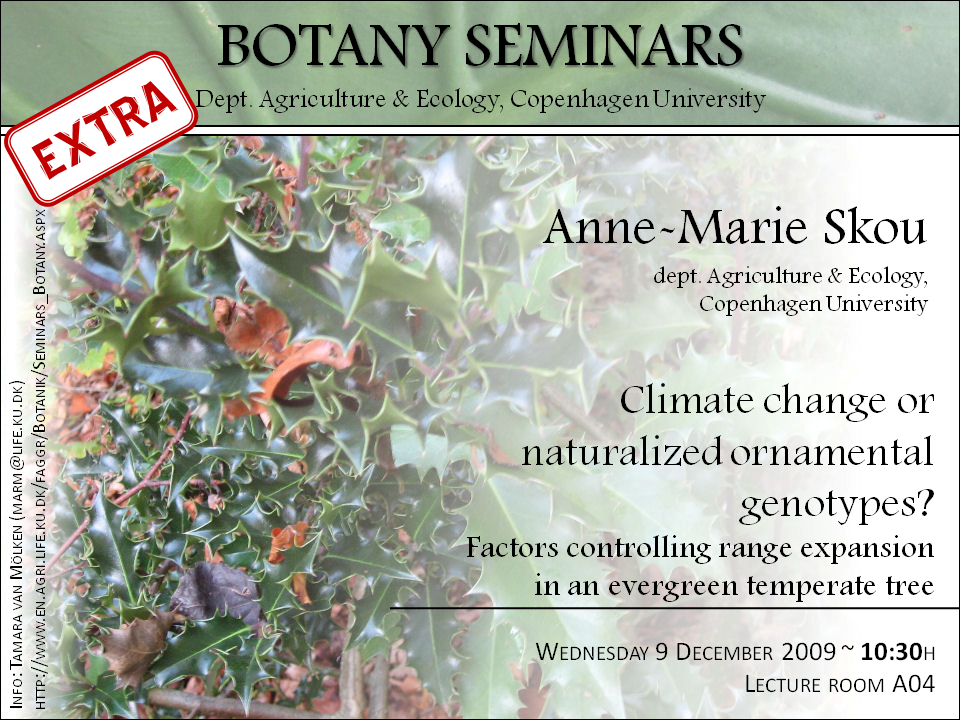
9 December 2009: Anne-Marie Skou


Climate change or naturalized ornamental genotypes? Factors controlling range expansion in an evergreen temperate tree

Anne-Marie Thonning Skou

dept. Agriculture & Ecology, Copenhagen University


Holly (‘Kristtorn’) (Ilex aquifolium) is a dioecious evergreen tree or shrub that grows as a sparse but usually gregarious understory element in deciduous forests of western and southern Europe. In Denmark, the plant is at its northeastern range margin in forests of eastern Jutland, and it seems to be controlled by winter frost, expanding its range eastwards (ca. 100 km within ca. 50 years). However, numerous (frost-hardy) cultivars have been introduced in this region, and the species is an invasive alien plant in Australia and naturalized in New Zealand and western North America. Factors controlling its range expansion include: higher winter temperatures in eastern Denmark (permitting factor), trade and plantations (driving factor), dispersal by birds (100 m per year?); leaf mining; time between planting and fruit maturation (limiting factors). The objectives of my PhD thesis are: to determine propagule pressure of I. aquifolium cultivars in Denmark over time, to investigate genetic differences between native and introduced genotypes of Ilex aquifolium; to analyze the degree of genetic introgression from garden cultivars into native populations; to study the frost tolerance of native and introduced genotypes, and survival in field transplant experiments; to determine whether thrushes have preferences for the fruit of different cultivars; and to assess the effects of introduced genotypes on plant-animal interactions of different specificity.


27 November 2009: Wibke Wille


Evolutionary Agroecology: developing high density, communal crop plants for weed suppression and increased sustainability

Wibke Wille,

dept. Agriculture & Ecology, Copenhagen University


Recent advances in our understanding of the role of size differences in competition among plants suggest that the potential for many crops to suppress weed is greater than generally appreciated. Increasing crop density and uniformity of spatial distribution reduces significantly weed growth and increases cereal yield under weed pressure. This potential can be further enhanced by developing varieties for such an environment, allowing farmers to drastically reduce or eliminate herbicides and energy-intensive forms of weed control.

One hypothesis is that certain forms of phenotypic plasticity that increase individual fitness, specifically the “shade avoidance response”, reduce the potential for weed suppression and high yield in high-density high-uniformity cereal cultivation systems. To test this hypothesis we have grown chemically mutated seeds of spring wheat under green shading selecting for plants deficient in shade avoidance as a potential source of genes to be introduced into high-yielding varieties for crowded, spatially-uniform cropping systems.


A second hypothesis is that there is a large potential for high-density weed-suppressing wheat ideotypes in the existing wheat germplasm, though the genetic characteristics optimizing this potential may have been lost over the past century of breeding cereals grown in rows at low density with mechanical or chemical weed control. We are testing this by growing a large collection of wheat lines from international cultivars and landraces in our high-density high-uniformity system to seek and document natural variation in weed suppression under these conditions.